
A temporary redirect where a permanent one belongs.
Found by Redirect checker →
The URL redirects back to itself and never settles.
Found by Redirect checker →
Structured data and schema validator
Parse JSON-LD, validate it against the bundled Schema.org vocabulary, report parse errors and build new markup with schema-build.
Structured data and schema validator
Check
schema-check validates the structured data a page publishes and reports what failed to parse.
Build
schema-build drafts JSON-LD for common types from the page.
Three steps, one saved scan
Validate against the Schema.org vocabulary
schema-check reads the page's structured data and tests every type and property against the bundled Schema.org vocabulary.
Check the markup as a graph
It maps which entities carry an @id, which are linked, which stand alone, and whether any @id reference points nowhere.
Build missing markup
schema-build suggests a connected @graph using only facts visible on the page, and lists the recommended fields still missing.
Checks in this feature
| Check | What it means | Severity | Evidence |
|---|---|---|---|
SCHEMA_VALIDATION_ERROR | The page's structured data has validation errors against the Schema.org vocabulary | Important | Validation error count per page |
STRUCTURED_DATA_PARSE_ERROR | A JSON-LD block is present but does not parse as valid JSON, so search engines ignore it | Important | Blocks found vs blocks parsed |
STRUCTURED_DATA_MISSING | The page has no Schema.org markup | Tip | Page with zero structured data blocks |
One command
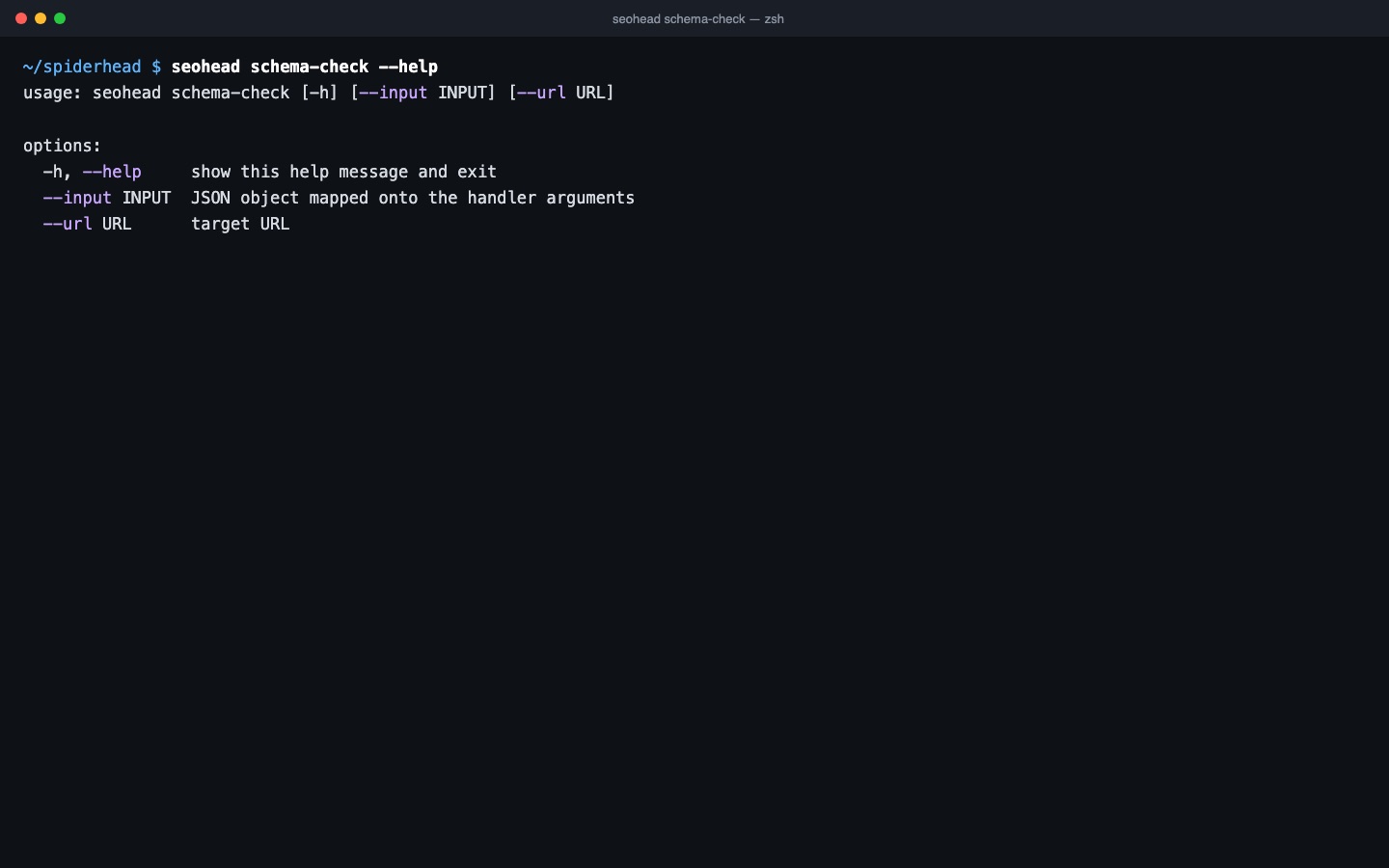
seohead schema-check --url https://example.com/productInstall first: installation guide. Every command also runs as an MCP tool for AI agents.
From the check registry
SCHEMA_VALIDATION_ERRORSTRUCTURED_DATA_PARSE_ERRORSTRUCTURED_DATA_MISSING