
301→302
A temporary redirect where a permanent one belongs. Found by Redirect checker →redirect loop
The URL redirects back to itself and never settles. Found by Redirect checker →

A temporary redirect where a permanent one belongs. Found by Redirect checker →redirect loop
The URL redirects back to itself and never settles. Found by Redirect checker →
Data sources
CrUX Core Web Vitals report
Field Core Web Vitals from the Chrome UX Report, kept separate from lab timings so the two are never confused.
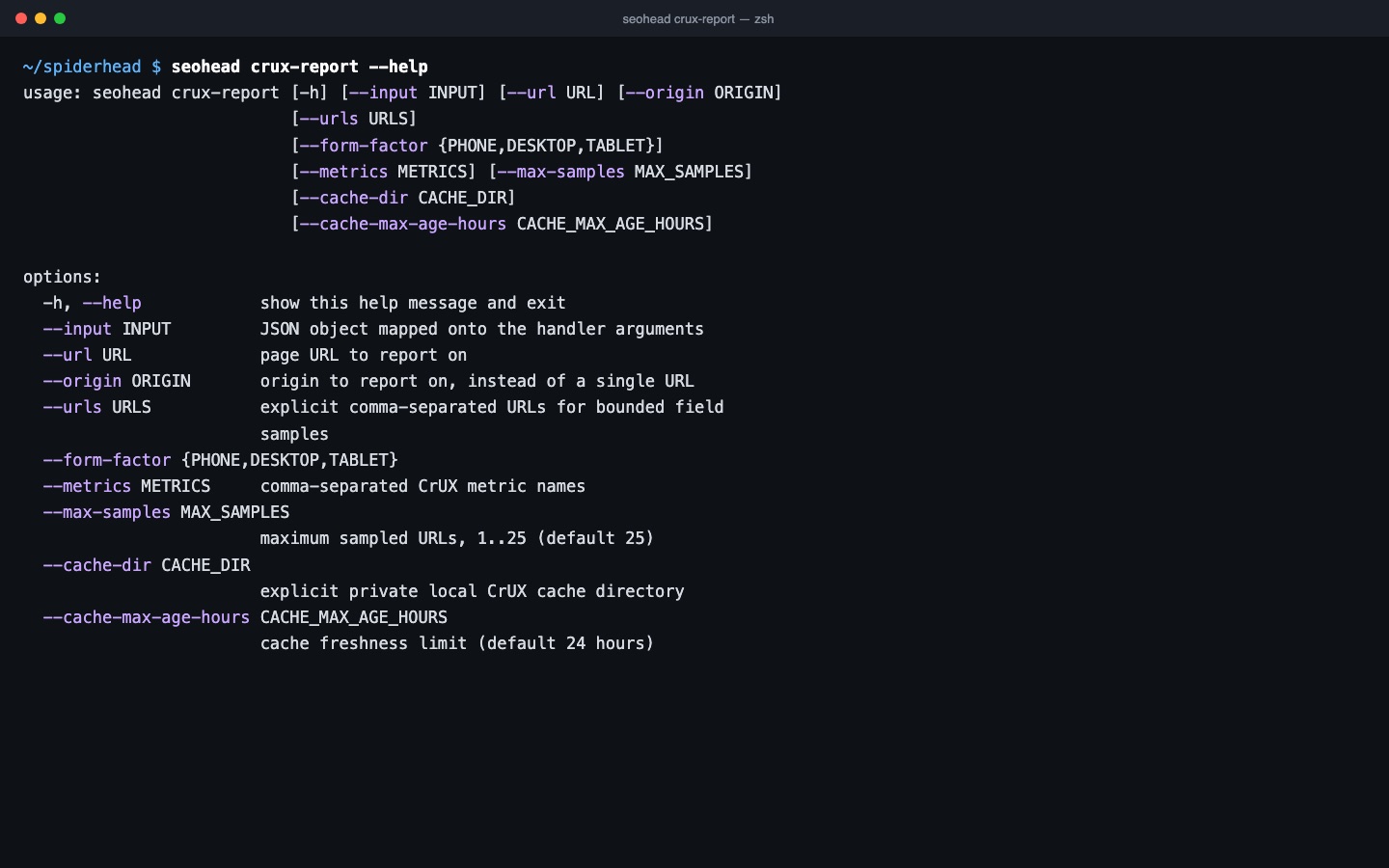
CrUX Core Web Vitals report
Credential-gated
crux-report needs your API key; without it the report says it did not run.
How it works
Three steps, one saved scan
Add your Google API key
Store a Chrome UX Report API key in the config path or CRUX_API_KEY. Without it the report says it did not run.
Pull field p75 for one URL
Run crux-report on a URL, optionally with --form-factor PHONE or DESKTOP, and get LCP, INP and CLS at the 75th percentile.
Read the verdicts against official thresholds
Each metric is marked good, needs improvement or poor using the web.dev limits (LCP 2.5/4 s, INP 200/500 ms, CLS 0.1/0.25). Missing data is shown as unavailable, never as passing.
How to run it
One command
bash
seohead crux-report --url https://example.com/Install first: installation guide. Every command also runs as an MCP tool for AI agents.
FAQ