
A temporary redirect where a permanent one belongs.
Found by Redirect checker →
The URL redirects back to itself and never settles.
Found by Redirect checker →
URL history across scans
See how one URL changed across retained scans: status, title, canonical, body and links, with a body diff between snapshots.
URL history across scans
Body diff
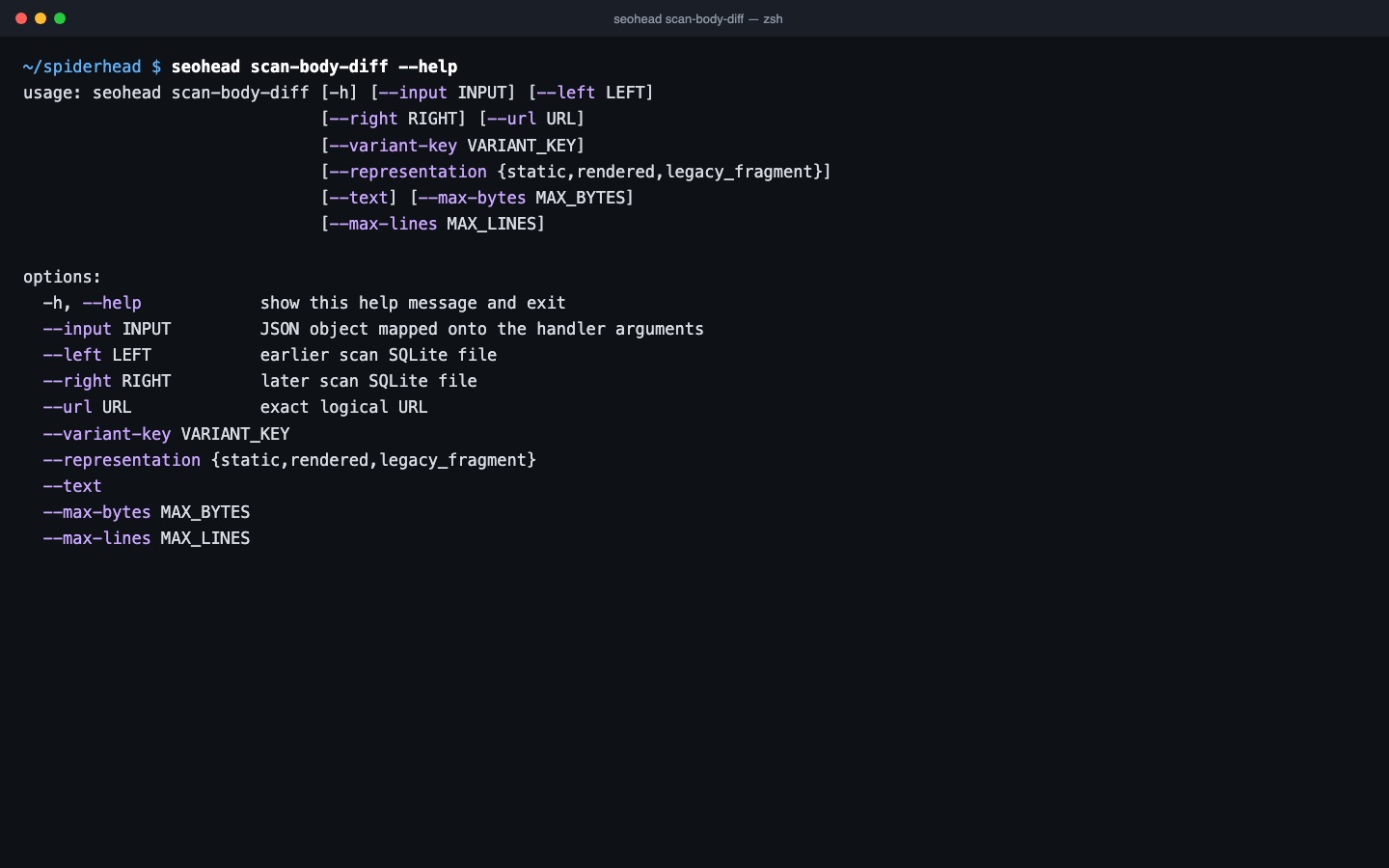
scan-body-diff compares retained bodies of the same URL.
Wayback
wayback-history adds archived snapshots for context.
Three steps, one saved scan
Keep scans in a project
Each crawl is saved as a SQLite scan file in the project's scans folder. Old scans stay readable, so you can look back at any URL.
Read one URL across scans
scan-url-history shows the status, indexability, title, canonical and redirect target of one URL in each retained scan, plus its body hash. Scans without the URL are marked absent.
Diff the body between two scans
scan-body-diff compares the retained body of the same URL in two scan files. Text output is capped by --max-bytes and --max-lines. wayback-history adds free Internet Archive snapshots for context.
One command
seohead scan-body-diff --left ./scans/a.sqlite --right ./scans/b.sqlite --url https://example.com/Install first: installation guide. Every command also runs as an MCP tool for AI agents.